
Sales Tax Compliance

Operate the full sales tax cycle, from source transactions and nexus signals through reviewed, filing-ready returns.

  • Expected-versus-collected tax review at transaction and period level
  • Date-effective state, county, city, and special-jurisdiction calculation context
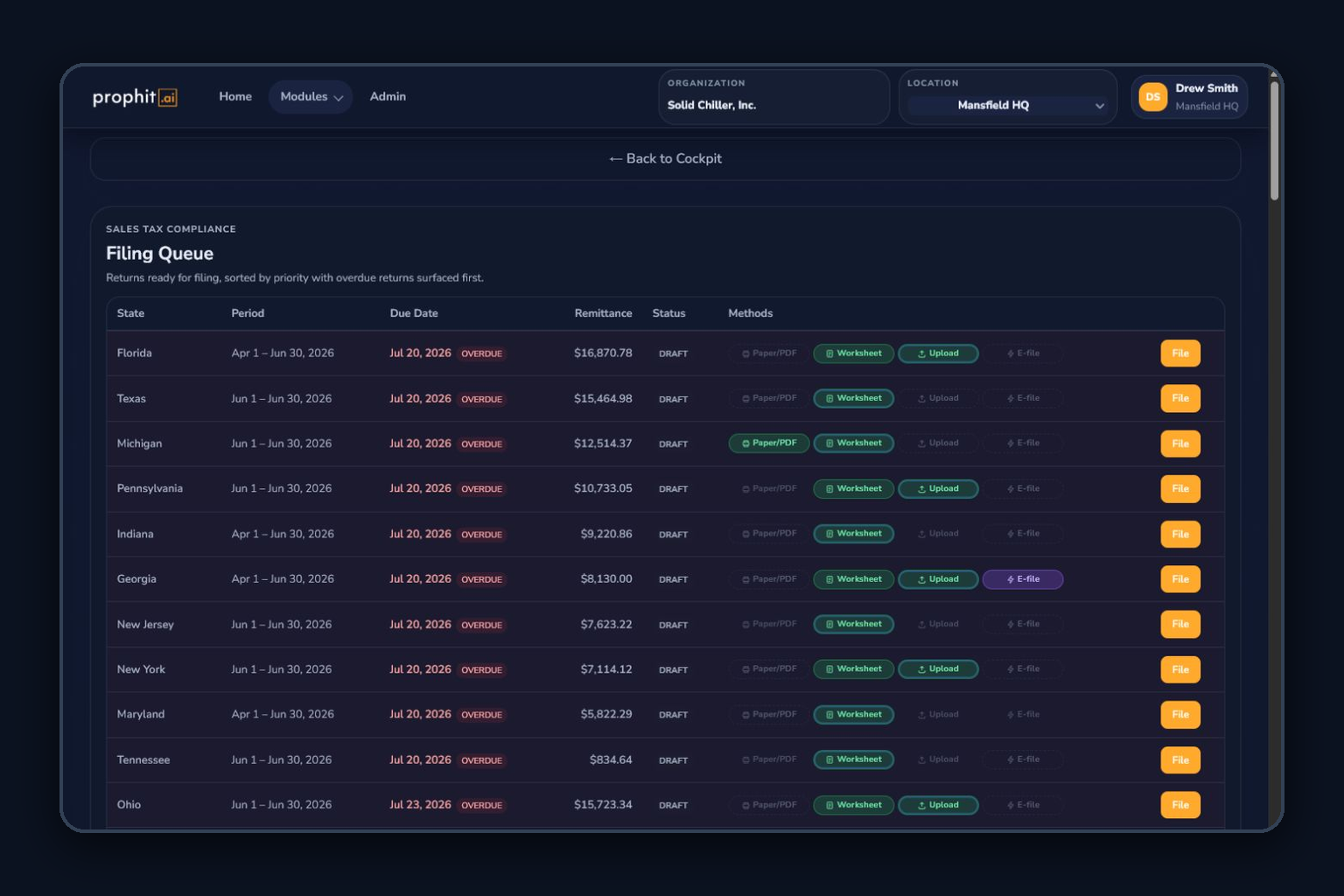
  • State return, schedule, worksheet, upload, and filing-lane details where supported
Sales Tax Compliance filing queue

How the work moves through ITMS

Sales Tax Compliance is the location-scoped operating workspace for tax teams that need to know what was sold, where it was sourced, what tax was expected, what was collected, and what must be prepared for filing.

It connects transaction ingestion, jurisdiction and product context, nexus and obligation monitoring, variance review, return preparation, and cross-location Returns Center visibility. Source evidence, calculation provenance, effective dates, and reviewer decisions remain attached throughout the process.

Inputs
  • Sales transactions and import batches
  • Transaction date, customer, ship-to, and situs facts
  • Product or service identity and taxability evidence
  • Tax collected, exemptions, nexus signals, registrations, filing frequency, return period, and state account setup
Operational outputs
  • Reviewed transaction determinations and variance decisions
  • State nexus, obligation, period, deadline, and readiness views
  • Return summaries, workpapers, named forms, local schedules, upload files, and filing packages where supported
  • Cross-location period status in the Sales Tax Returns Center

See the jurisdiction, effective-date, and return details in the Sales Tax Atlas

The Sales Tax Atlas opens the research behind state treatment and filing context. Each state profile brings rate and sourcing structure, product observations, effective windows, marketplace treatment, certificate references, holidays, return identity, and filing posture into one place.

Explore the Sales Tax Atlas
  • Alabama profiles distinguish city limits, county, and police-jurisdiction questions and identify ONE SPOT reporting.
  • Georgia ST-3 and Kansas ST-36 profiles show how return identity and local allocation structure affect the filing workflow.
  • Hawaii profiles connect periodic G-45 reporting with annual G-49 reconciliation.
  • Atlas research and production calculation support are labeled separately so coverage stays explicit.

From transaction data to a controlled filing handoff

The module preserves the chain from source data through calculation and review so the number on a return can be traced back to the transactions and decisions behind it.

  1. 01

    Connect or upload sales activity

    Bring in structured sales files, configured QuickBooks and Stripe feeds, read-only SAP S/4HANA Cloud, Oracle Fusion Cloud, and NetSuite Period Review imports, or API-driven transactions for the active organization and location.

  2. 02

    Normalize the compliance record

    Standardize customer, address, product, amount, tax, exemption, and source metadata while retaining import history and downloadable source artifacts.

  3. 03

    Resolve jurisdiction and tax treatment

    Apply transaction date, ship-to and situs facts, product or service identity, exemption context, and date-effective rate content. Ambiguous jurisdiction or treatment evidence is flagged for review.

  4. 04

    Compare expected and collected tax

    Review calculated tax, tax collected or accrued, effective rate, difference, materiality, and reason-coded variance candidates at the line and period level.

  5. 05

    Monitor where filing work is required

    Track economic and physical-presence signals, approaching thresholds, registration and obligation status, monthly, quarterly, semiannual, annual, or custom frequency, period start and end dates, due dates, and state readiness.

  6. 06

    Prepare, review, and hand off returns

    Generate filing-ready workpapers and jurisdiction-specific artifacts by supported filing lane. Manage return identity, period, form version, account fields, local schedules, submission files, and review status through the Sales Tax Returns Center.

What your team can operate

Data sources and calculation

Build a reviewable sales-tax record across commerce, accounting, ERP, and tax sources.

  • Manual and mapped-file imports with import history, validation, and source-artifact downloads
  • Configured accounting, commerce, ERP, and API transaction flows
  • State, county, city, district, police-jurisdiction, and jurisdiction-code context when supported by the governing source
  • Transaction-date calculation with effective content windows, source vintage, rounding, exemptions, and tax-paid context
  • Real-time calculation through API Access where the program is configured for it

Review and obligation management

Focus the team on decisions that can change exposure or a return.

  • Transaction cockpit with filters, line detail, reason codes, and materiality
  • Expected-versus-actual variance candidates with explain, adjust, accept, and resolve states
  • Economic nexus threshold tracking and physical-presence evidence
  • Registration, filing obligation, frequency, period start, period end, deadline, and readiness tracking by state
  • Prior-period remittance comparison as a materiality basis where configured

Returns and evidence

Move reviewed numbers into a filing process without losing their audit trail.

  • Monthly, quarterly, semiannual, annual, and custom-period summaries with state liabilities and remittance context
  • Return name, form version, taxpayer account fields, deductions, local schedules, and marketplace reporting fields where applicable
  • Filing-ready packages, workpapers, portal worksheets, upload files, and forms for supported state lanes
  • Org-wide Sales Tax Returns Center for due-soon, blocked, ready, and filed periods
  • Certificate-aware treatment and links to sales exemption evidence where configured

What stays explicit

Human review stays in the loop

AI-assisted classification and variance explanations accelerate review. Tax treatment and filing approval remain recorded reviewer decisions.

Coverage is explicit

Jurisdiction, calculation, workpaper, upload, portal, paper, and direct e-file readiness are surfaced as separate capabilities.

Evidence before certainty

Address, product, exemption, and authority evidence must support the result. Unresolved facts remain visible exceptions or fail-closed states.

Core compliance, scaled to your operating model

Sales Tax Compliance is available from Starter upward. Multi-location operations, configured connectors, API calculation, advanced filing programs, and enterprise controls depend on plan, module activation, and implementation scope.

Ready to plan the next step?

Map your data sources, jurisdictions, filing lanes, integrations, and review controls to a Sales Tax Compliance operating model.

  • Flat pricing per organization: $199/month Starter and $599/month Professional, with no per-state, per-filing, or per-transaction fees — plus a published à-la-carte module menu.
  • Marketplace-facilitator sales are recognized and treated distinctly from direct sales, so facilitator-collected tax is not double-counted.
  • Human review is a designed control: filing-ready outputs are approved by a reviewer, and unresolved facts fail closed instead of being guessed.