
Sales tax compliance software and real-time calculation engines for finance, tax and engineering teams. Connect source data, reviewable determinations and filing-ready workpapers.
Which describes you?
Choose one path. We will show you the workflows, the controls, and the right next step for the way you work.
One tax operation. Clear workflows.
Move from source data to calculation and filing without losing the evidence trail.

Rates are the beginning of the tax question.
Explore state rules, local-rate structures, forms, marketplace treatment, exemptions, and product-specific wrinkles in the Sales Tax Atlas.
Explore the Sales Tax Atlas
- Rates and local structure
- Forms and filing context
- Taxability and product wrinkles
- Sources and review dates
Your team can use ITMS. Your AI agents can, too.
Your AI agent can work with Prophit.ai’s AI agent through governed interfaces. Give it the documentation and authorized credentials, and it can prepare and explain supported organization, data, calculation, certificate, and compliance work while logging, throttling, scoped credentials, and deterministic fail-closed modes keep the work controlled.
 ITMSRules, evidence, and authority checks
Start with a job you already need done.
Your AI agent can ask Prophit.ai to prepare the work, return the evidence, and stop at the actions that still require your approval.
Each example runs inside your plan, configuration, and jurisdiction coverage. Filing, payment, and outreach keep the separate authority they always require.
Build the tax operation you actually need.
Sales and purchasing remain independent engines. Shared evidence and a neutral returns workflow connect them only where the filing process requires it.
Sales Tax Compliance
End-to-end sales tax workflow for ingest, jurisdiction-aware calculation, nexus monitoring, and filing-ready packages. Get the right numbers onto the right returns, on time, in the right jurisdictions.
Explore module →Purchasing Tax Compliance
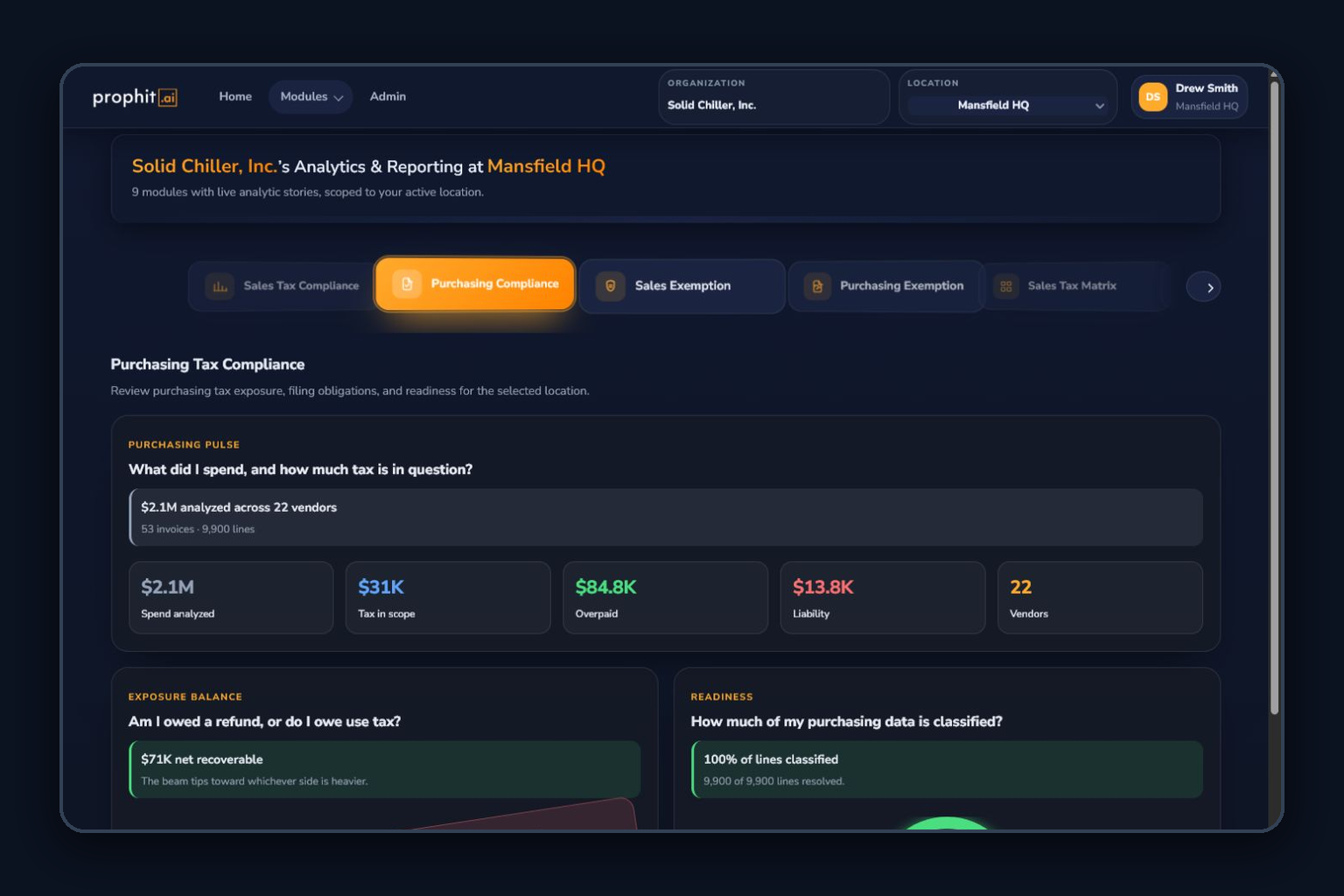
Use tax and purchasing tax compliance for AP data, vendor-charged tax review, exemption-aware classification, and filing-ready use tax outputs. Teams can identify underpayments, overpayments, and accrual exposure in one review flow.
Explore module →Exemption Certificate Management
Sales and purchasing exemption certificate workflows with intelligent validation, lifecycle tracking, expiration controls, renewal automation, and connected tax-decision support.
Explore module →Risk & Recovery
Historical tax review and remediation workflows that separate recoverable overpayments from exposure, preserve the evidence behind each finding, and move approved work into claims or voluntary disclosure projects.
Explore module →Intelligence & Automation
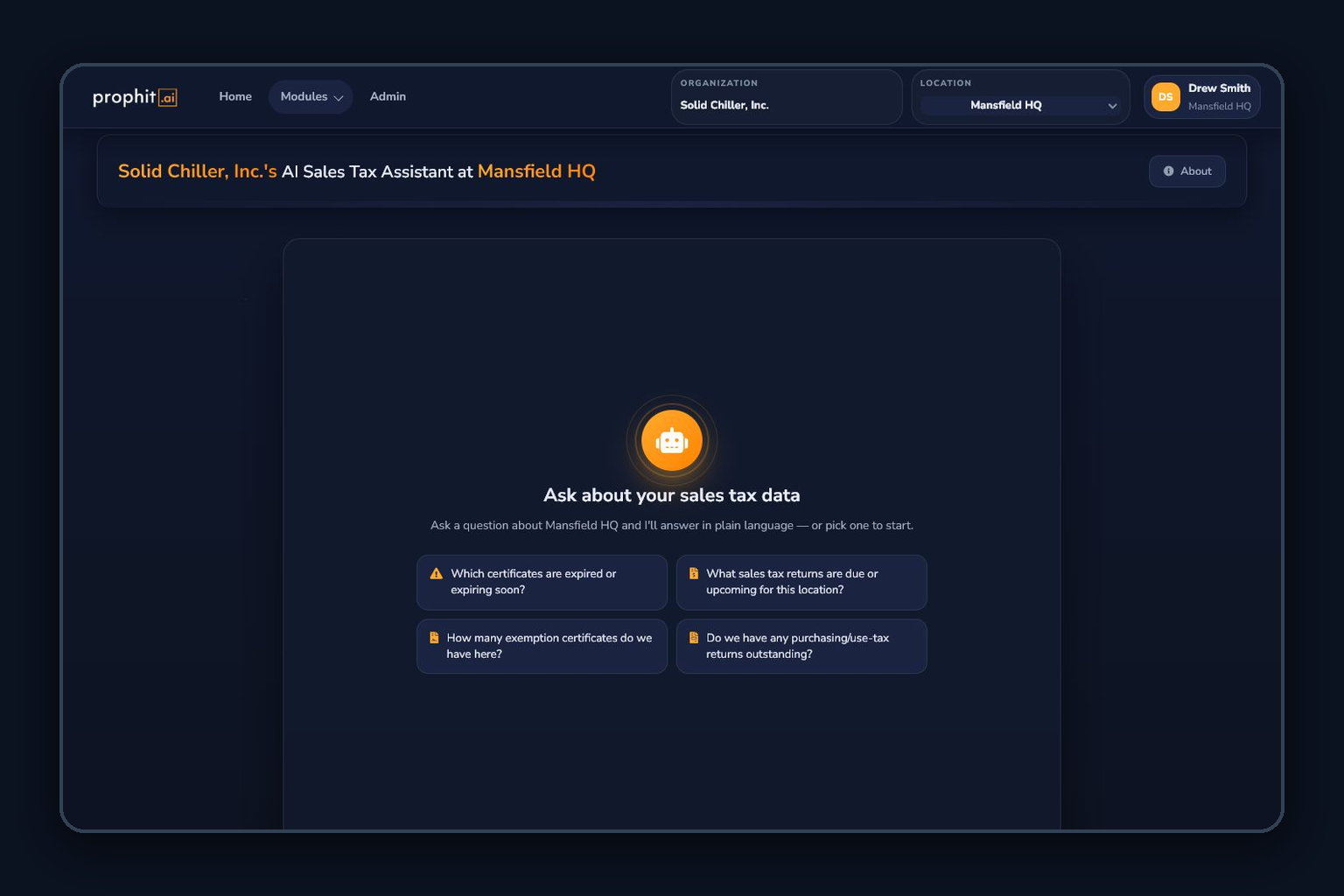
Three review-controlled automation layers: the AI Sales Tax Assistant for cross-module inquiry and task support, Sales Tax Matrix for configuration quality, and Invoice Auto-Processing for document-to-data preparation.
Explore module →Reconciliation
Cross-system tax tie-out for billing, payment, ERP/GL, AP, tax engine, preparer, and filed-return totals, with sales and purchasing domains, material exceptions, evidence, and fail-closed approval controls.
Explore module →Analytics & Reporting
Location-scoped analytic stories for each active module, using purpose-built maps, gauges, funnels, treemaps, timelines, balance views, and status clusters to explain the work behind the totals.
Explore module →API and AI agent access
Connect approved systems and AI agent runtimes to documented ITMS interfaces with explicit authority limits.
Explore AI agent access →Two determination engines, built for the moment tax is decided.
Calculation is a different job from compliance, so we built it as its own product. Each engine answers before a transaction is finalized, returns the result to the system that asked, and hands the committed determination to the compliance workspace — which checks it again at period close.
Sales Tax Engine
Real-time sales tax determination for checkout, billing, and ERP: rooftop address resolution, boundary-verified jurisdictions, source-pinned rates, and a quote to commit lifecycle that returns the answer to the source system.
Explore the engine →Use Tax Engine
Consumer use tax determination during purchasing: compare vendor-charged tax with the treatment the purchase requires and export reviewed accruals. Native accounting posting requires a validated customer-specific integration.
Explore the engine →Integrate through the documented API today, or connect billing, accounting, and purchasing data sources. The engines’ content layer is public: every rate they resolve is published, with its official source, in the Sales Tax Atlas.
See every workflow in one operating view.
Move through calculation, purchasing review, certificates, risk, automation, and reporting without losing the connection between the work and its evidence.
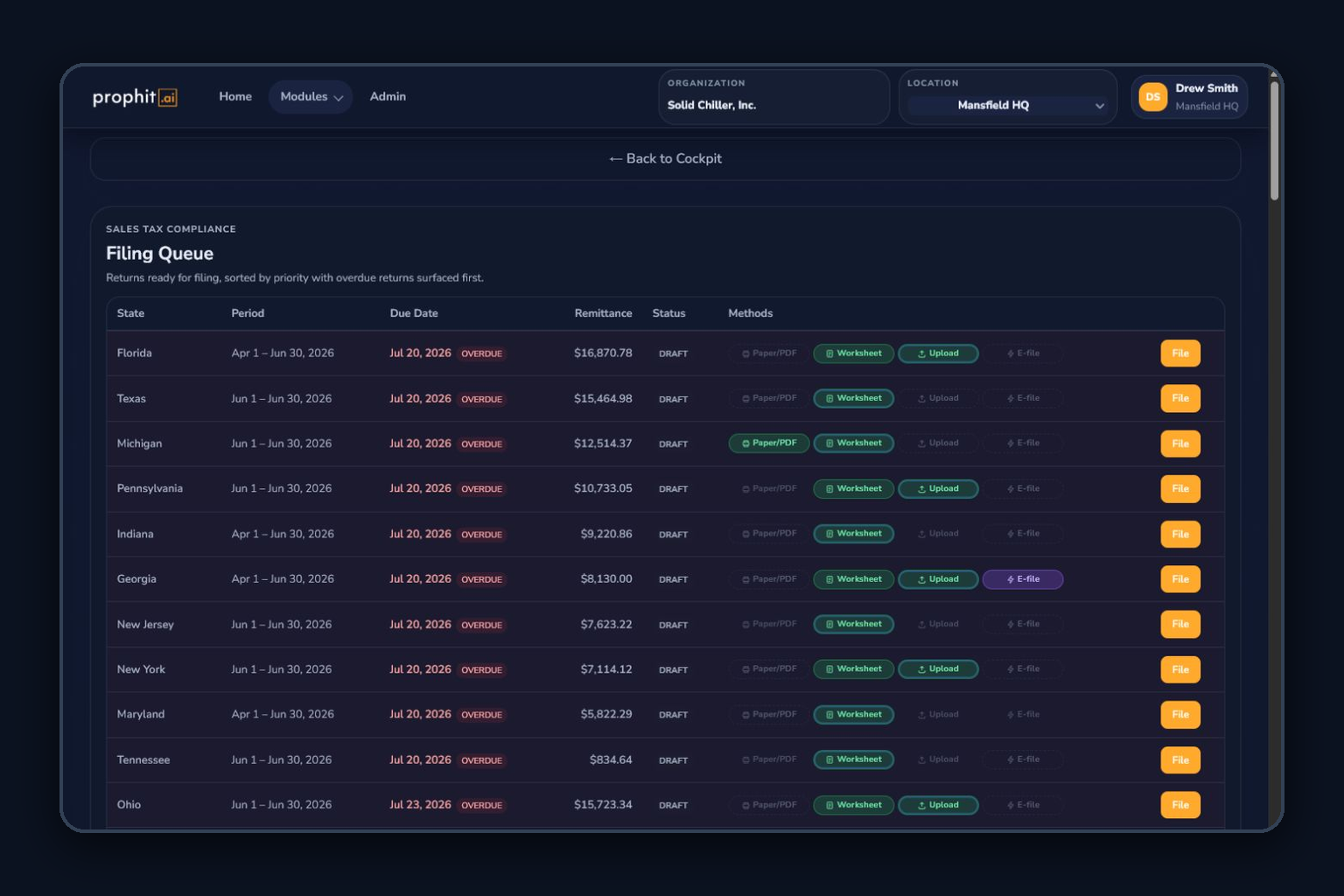
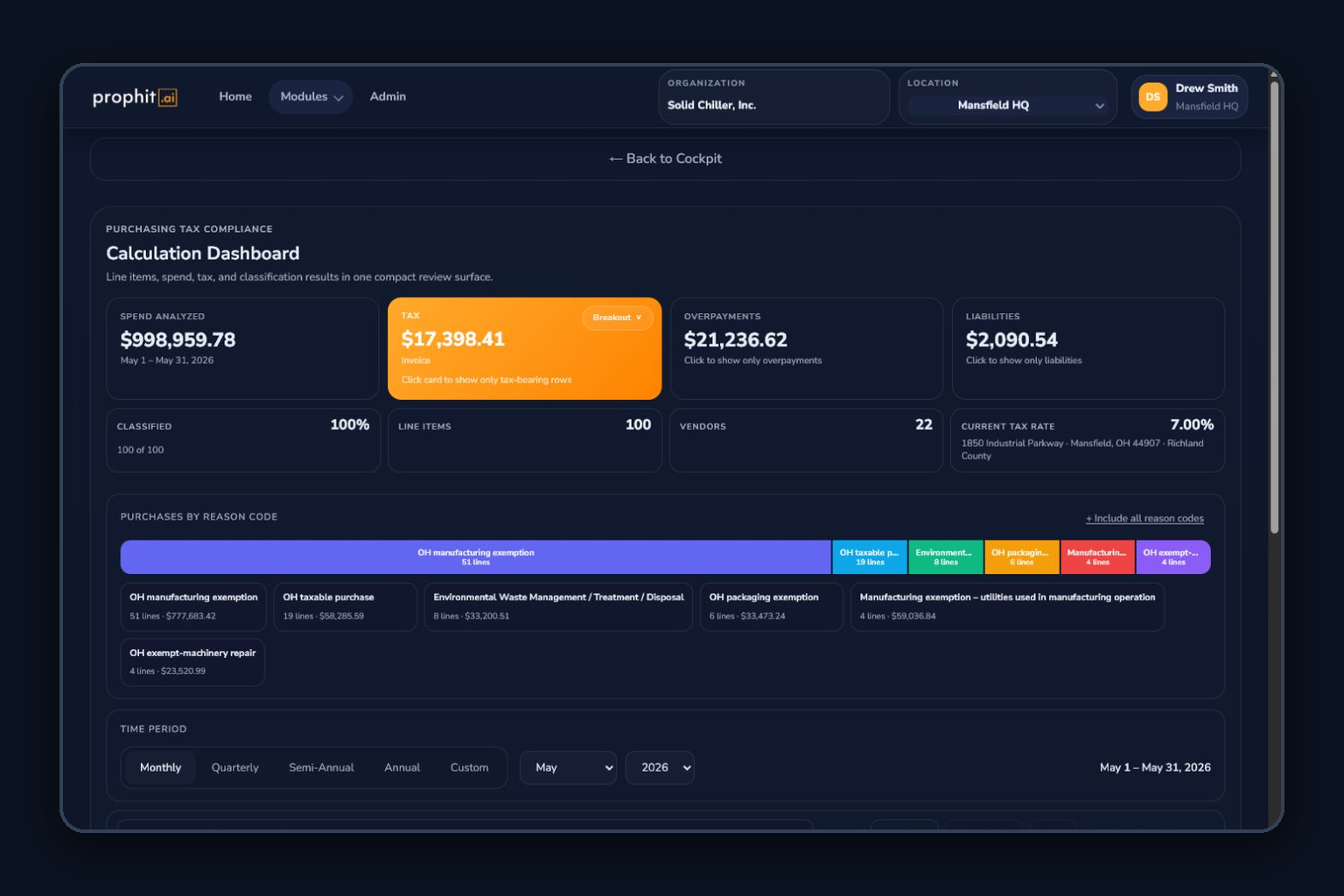
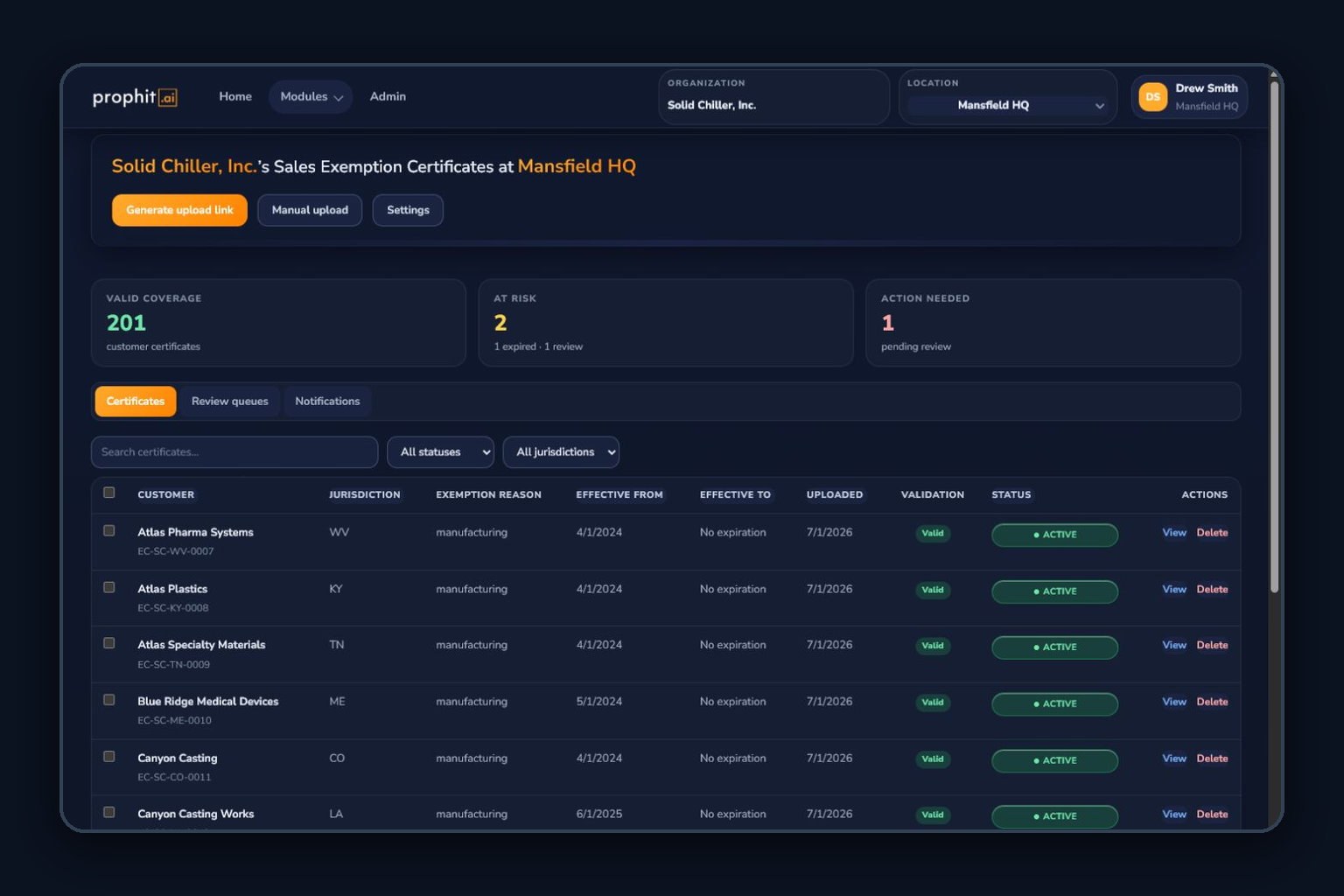
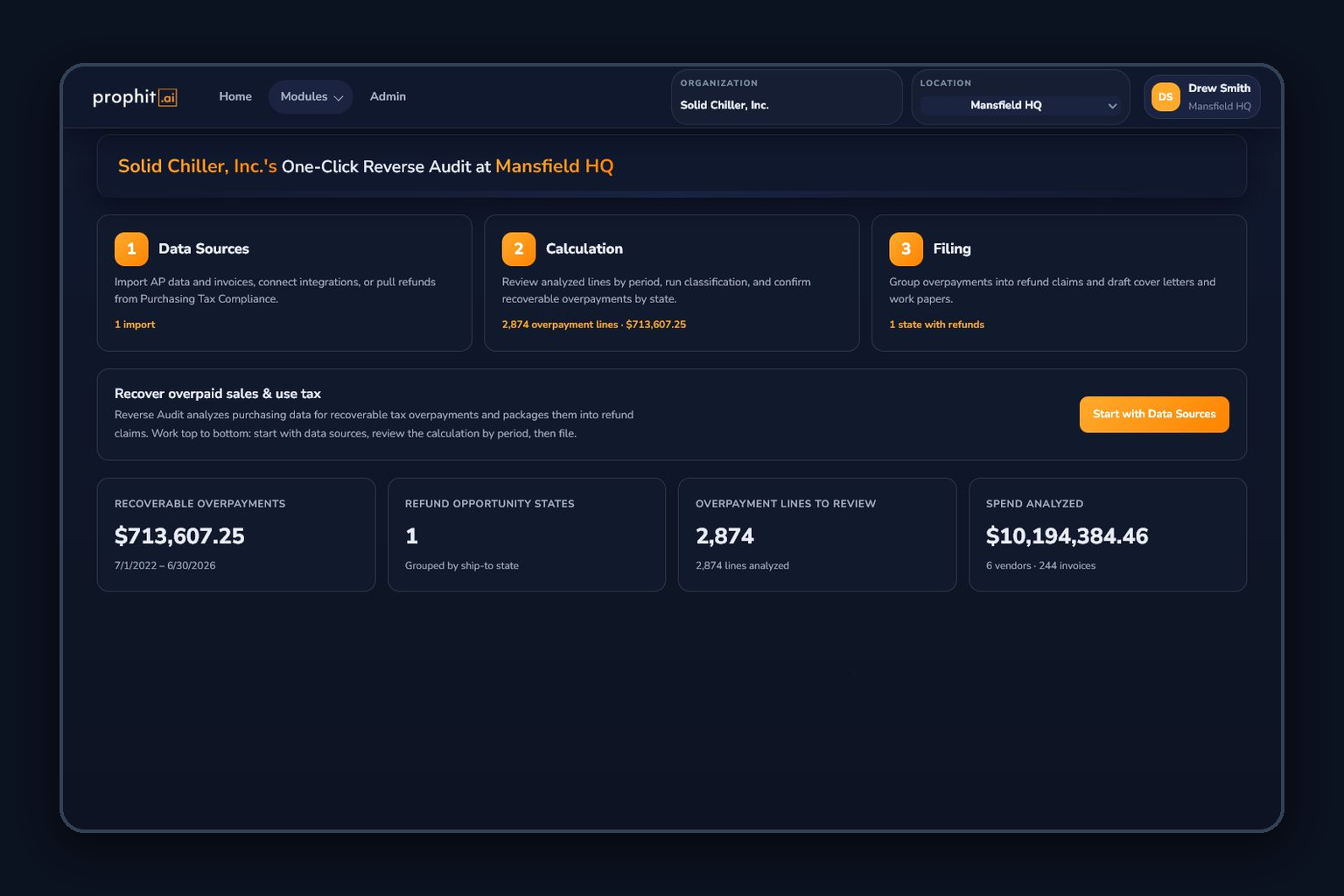
Tracking the line where tax changes.
Follow Prophit.ai’s agentic boundary investigator as it examines real geotagged street imagery for mailbox candidates.
Follow SITUS-1 live ↗

Show us the tax operation you’re trying to improve.
Tell us who you are and where the friction sits. We’ll plan a focused conversation around the workflows that matter. You will not have to sit through a generic demo.
Choose a time with the Prophit.ai team.
See live availability and book the team member covering the right workflow without leaving this page.