
Risk & Recovery

Find overpayments and exposure, preserve the evidence, and move reviewed findings into recovery or remediation work.

  • Historical AP and invoice review for overpayments and use-tax exposure
  • Evidence-linked findings, prioritization, claim tracking, and exports
  • State-oriented voluntary disclosure projects and remediation workpapers
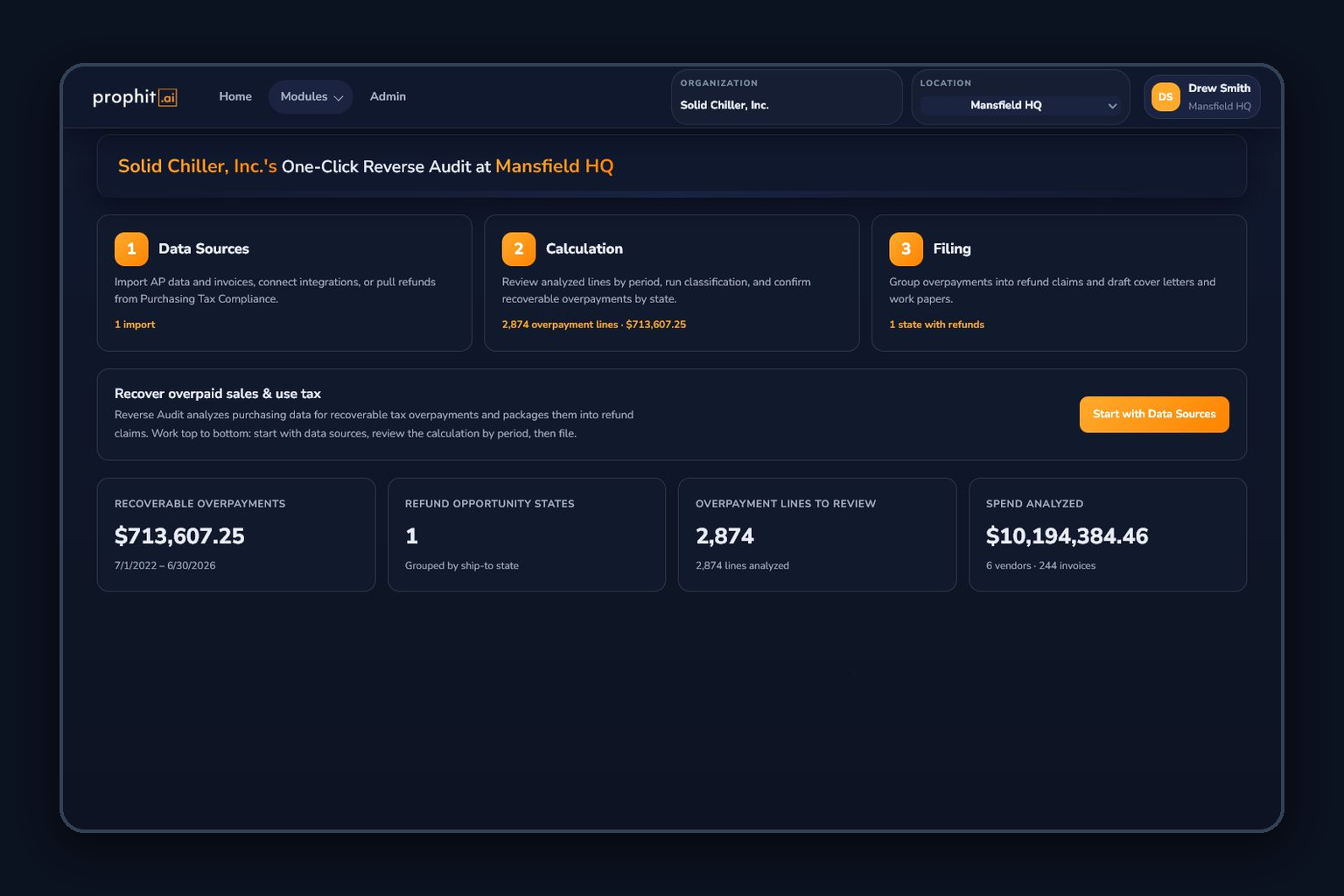
Risk and Recovery reverse audit dashboard

How the work moves through ITMS

Risk & Recovery brings together One-Click Reverse Audit for historical purchase-tax review and Voluntary Disclosure Automation for structured exposure remediation.

Evidence and findings flow between these workflows and the compliance modules. Recovery claims and disclosure projects retain their own records outside day-to-day period close.

Inputs
  • Historical AP, payment, ERP, and invoice data
  • Purchasing Tax Compliance refund and liability opportunities
  • Sales or use-tax exposure summaries and jurisdiction context
  • Supporting invoices, documents, notes, and reviewer evidence
Operational outputs
  • Prioritized recovery and exposure findings
  • Evidence-linked workpapers and exportable analyses
  • Recovery claim records and workflow status
  • State-grouped VDA agreements, liability summaries, cover letters, and schedules

From historical transactions to an owned next step

The module distinguishes recoverable dollars from exposure and gives each finding a documented path forward.

  1. 01

    Define the review population

    Upload AP, payment, ERP, and invoice history or import eligible opportunities from Purchasing Tax Compliance for the active location.

  2. 02

    Classify tax treatment

    Use document and transaction context to compare vendor-charged tax with expected treatment and identify both overpayment and underpayment signals.

  3. 03

    Prioritize material findings

    Group opportunities by state, vendor, reason, amount, evidence, and confidence so reviewers can focus on the highest-value work.

  4. 04

    Validate and document

    Link invoices and supporting evidence, record reviewer decisions, and prepare explainable workpapers or claim support artifacts.

  5. 05

    Pursue recovery

    Move approved overpayment findings into claim-oriented tracking with evidence, review status, and an authority-dependent outcome.

  6. 06

    Remediate exposure

    Route reviewed liabilities into state-grouped draft disclosure agreements, quantify the covered period, and generate a review-only cover letter and state schedule.

What your team can operate

One-Click Reverse Audit

Accelerate the search for money and risk hidden in purchase history.

  • Batch invoice, AP, payment, and ERP-history intake
  • Purchasing Tax Compliance opportunity import
  • AI-assisted overpayment and exposure analysis with line-level review
  • State, vendor, materiality, reason, and evidence-based prioritization

Recovery workflow

Turn a validated opportunity into organized follow-through.

  • Evidence-linked findings and invoice context
  • Recovery summaries, exportable analyses, and workpapers
  • Claim records, status, ownership, and supporting documentation
  • Separation between draft opportunities and approved recovery action

Voluntary Disclosure Automation

Give historical exposure a controlled remediation workspace.

  • Liability intake from sales, purchasing, and reverse-audit workflows
  • Period and ship-to-state liability aggregation with source-line snapshots
  • Draft agreements with anonymous or identified framing and explicit status
  • Review-only anonymous cover letters, state schedules, and readiness summaries

What stays explicit

Findings require validation

AI accelerates classification and prioritization. Material recovery and exposure conclusions remain recorded reviewer decisions.

Recovery outcomes remain authority-dependent

An identified overpayment becomes a documented claim candidate. Refund and disclosure outcomes depend on the authority, evidence, filing posture, and advisor judgment.

Not legal advice

Voluntary Disclosure Automation organizes data, documentation, and workflow. Tax and legal advisors retain responsibility for material disclosure decisions.

Configured enterprise workflows

One-Click Reverse Audit and Voluntary Disclosure Automation are enabled by plan, module activation, contract terms, and engagement scope. Availability is shown for each location.

Ready to plan the next step?

Define the historical population, evidence available, materiality, recovery goals, and remediation responsibilities for your program.