
Confirm documents are exemption certificates, check completeness, extract data, and guide corrections when validation fails.
Exemption certificate management software
Collect, review and renew certificates. From $49/month per location per side.
250 active certificates per side. Choose customer or vendor certificates; our team confirms scope before activation. Also included in the core compliance bundles.
Monitor state legal expiration rules, user-defined internal policies, and proactive notifications before certificates lapse.
Connect valid certificates to sales tax, purchasing tax, and use tax review — not a disconnected file cabinet.
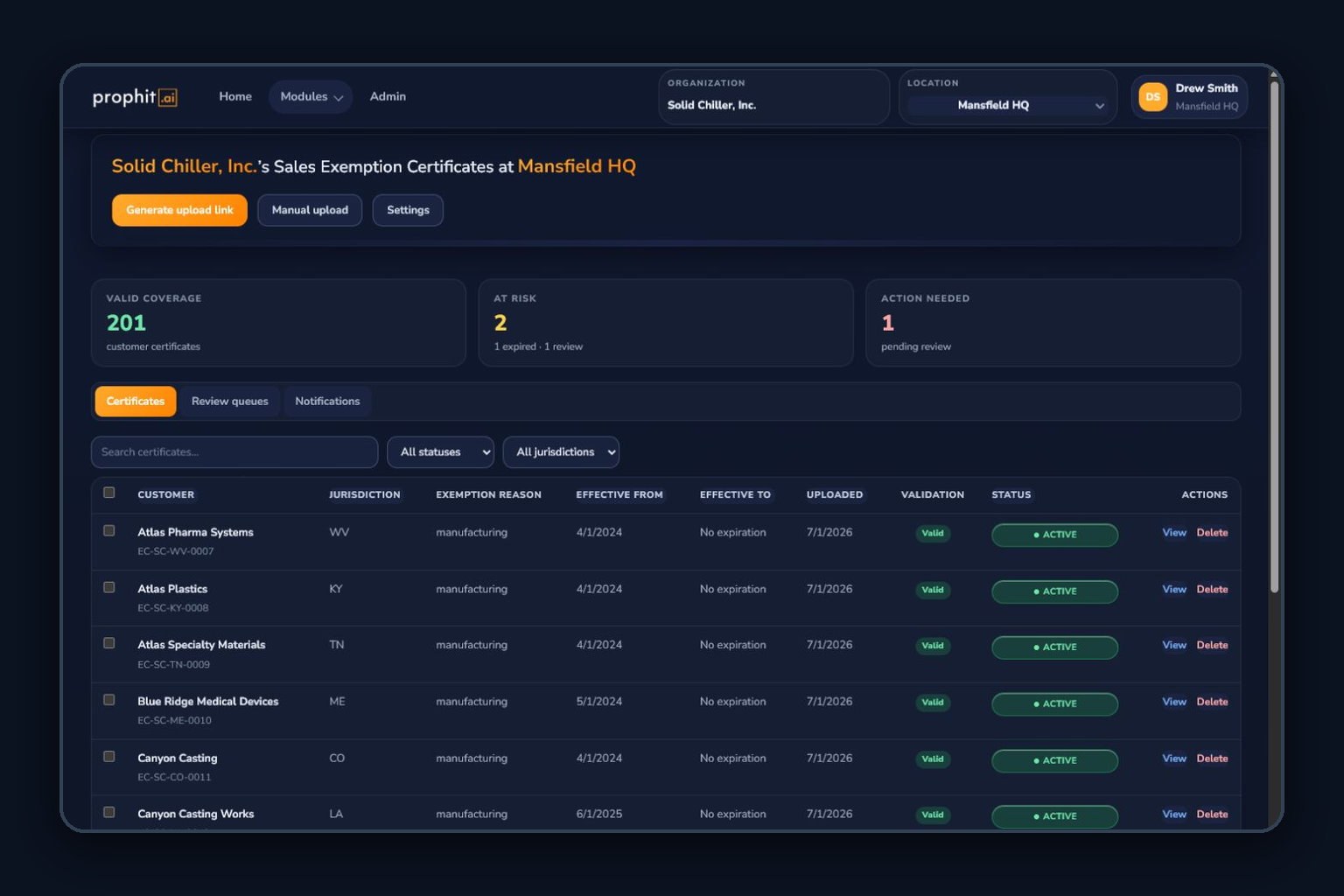
Evaluate a document from intake to review.
Use a sample certificate with a missing signature or mismatched customer. Intake acceptance is not approval of exempt treatment. The reviewer needs the document, the issue and the evidence for a decision.
- 01
Collect: upload a sample or use a configured secure customer link; retain the original document and customer or vendor mapping.
- 02
Review: inspect intake warnings, required fields, jurisdiction and effective dates. Request a correction where needed; unresolved evidence stays for review.
- 03
Retain: review the corrected document and its history, then confirm applicability before relying on it in a sales or purchasing tax decision.
Validate the certificate workflow before buying
Test certificate validity, missing evidence, expiration and reviewer decisions using your actual exemption scenarios.
Exemption certificates break down when they live outside the tax workflow.
Certificates sit in email folders, shared drives, ERP notes, and customer or vendor portals. Expiration rules vary by state and by internal policy. Sellers need customer certificates. Purchasers need vendor certificates. Certificate status affects tax decisions — but the evidence rarely travels with the transaction.
Scattered storage
Certificates live in inboxes, folders, and portals instead of a connected compliance workspace.
Expiration complexity
State legal rules and internal policies create renewal work that spreadsheets cannot scale.
Sales-side gaps
Customer certificates need validation, renewal, and connection to exempt sales treatment.
Purchasing-side gaps
Vendor certificates and exemption opportunities need tracking tied to AP and use tax review.
Tax decision context
A certificate on file does not help if tax teams cannot see it at review time.
Evidence risk
Audits and period-close review need original documents and lifecycle history, not just filenames.
From intake to a certificate-aware tax decision.
The module manages the document, the facts extracted from it, its validity over time, and the transaction workflows that rely on it.
- 01
Collect: upload individually or in bulk, or send customers and vendors secure upload and renewal links.
- 02
Validate: confirm the document is an exemption certificate, check completeness, extract the data, and guide corrections.
- 03
Track: apply state legal expiration rules and your internal policies; get notified before certificates lapse.
- 04
Renew: run individual or batch renewal workflows with secure links, keeping prior versions as evidence.
- 05
Connect: certificate status informs sales tax, purchasing tax, and use tax review; a reviewer approves the treatment.
- 06
Retain: original images, extracted data, and lifecycle history stay available for period close and audit support.
Customer exemption certificates with validation, renewal, and sales tax context.
On the sales side, exemption certificates come from customers. Prophit.ai supports intake, validation, expiration tracking, renewal workflows, and connection to sales tax treatment where valid certificates apply.
Individual and bulk upload
Upload customer certificates directly or import batches into a connected workspace.
Secure customer upload links
Collect certificates from customers through secure upload links where configured.
Validation and correction guidance
Validate certificate documents, check completeness, and guide corrections when validation fails.
Expiration and renewal notices
Track expiration dates, notify internal users, and send customer renewal notifications where supported.
Batch renewal workflows
Run individual or batch renewal workflows with secure renewal and upload links.
Sales tax treatment context
Connect valid certificates to sales tax review and exempt treatment where configured.
Vendor exemption certificates, generation, and use tax context.
On the purchasing side, certificates are certificates your organization provides to vendors — or certificates already in place. Prophit.ai supports intake, tracking, validation, vendor issuance, and connection to purchasing and use tax review.
Ingest existing certificates
Bring purchasing exemption certificates into a tracked workspace with lifecycle visibility.
Validation and completion review
Review certificate completeness and validation status before relying on exempt treatment.
State-specific generation
Generate state-specific exemption certificates with prepopulated data where supported.
Vendor issuance
Issue certificates to vendors through configured workflows where supported.
Vendor exemption opportunities
Identify vendor exemption opportunities from purchasing patterns where configured.
Use tax and purchasing context
Connect exemption status to purchasing tax compliance and use tax review workflows.
Add sales tax compliance or calculation when your workflow needs it.
Exemption certificates affect both sides of indirect tax. Prophit.ai connects certificate lifecycle management to sales tax compliance, purchasing tax compliance, use tax review, and filing-ready workflows across the platform.
Sales Tax Calculation Engine
Return a tax determination to checkout, billing or your ERP. Evaluate the quote-to-commit API, supported jurisdictions and exception behavior.
Explore the calculation engineSales tax software
See how exemption certificates connect to the broader sales and use tax lifecycle.
Explore sales tax softwareUse tax software
Connect purchasing-side certificate context to use tax and vendor-tax review.
Explore use tax softwareSwitching from Avalara ECM?
How Prophit.ai compares with Avalara on certificates, pricing model and auditable content — including when Avalara is the better choice.
Read the Avalara comparisonTax-exempt purchasing software
What to look for when comparing vendors for exempt purchases, vendor-charged tax review, and use tax accrual.
Compare tax-exempt purchasing vendorsSales Tax Compliance module
Review sales-side transactions, obligations, and filing-ready packages with certificate context.
Explore sales tax compliancePurchasing Tax Compliance module
Review vendor-charged tax, use tax exposure, and exemption-aware purchasing workflows.
Explore purchasing complianceCertificate documentation
Step-by-step product documentation for sales-side and purchasing-side certificate workflows.
Read the docsExemption certificate management across Starter, Professional, and Enterprise.
Sales and purchasing exemption certificates are included across Starter, Professional, and Enterprise plans. Starter fits focused sellers organizing core certificate workflows. Professional adds multi-user collaboration, analytics, and AI-assisted review. Enterprise supports configured workflows, controls, integrations, and service scope.
Core certificate workflows — $199/month flat
Sales and purchasing exemption certificates for individuals and small teams getting organized. One user, one location.
Team-scale certificate operations — $599/month flat
Up to 5 users and 4 locations; multi-user workflows, analytics, renewal automation, and connected review.
Configured certificate programs — custom
Enterprise controls, integrations, managed support scope, and configured renewal workflows where supported.
Common questions.
Is there an alternative to buying exemption certificate management as an add-on?
Yes. Prophit.ai includes sales-side and purchasing-side exemption certificate management in every plan, including the 30-day free trial, rather than licensing it as a separate product tier alongside a calculation engine. Avalara, by contrast, publishes Exemption Certificate Management as its own product line with Essentials, Pro and Premium tiers (read from avalara.com on 2026-08-23). See the Avalara comparison for the structural differences and for when Avalara is the better choice.
What is exemption certificate management software?
Exemption certificate management software helps teams collect, validate, track, renew, and retain sales and purchasing exemption certificates — and connect certificate status to tax review workflows instead of treating certificates as disconnected files.
How much does exemption certificate management software cost?
With Prophit.ai it is available standalone at $49/month per location per side with 250 active certificates per side. Core certificate modules are also included in Starter ($199/month flat) and Professional ($599/month flat). Activation and scope are confirmed with our team.
Is exemption certificate management just document storage?
No. Prophit.ai is designed for intelligent validation, lifecycle tracking, expiration controls, renewal workflows, evidence retention, and connected sales and use tax compliance — not a passive file cabinet.
Can Prophit.ai manage both sales and purchasing exemption certificates?
Yes. Prophit.ai supports customer exemption certificates on the sales side and purchasing-side certificates your organization provides to vendors or receives from existing vendor relationships.
Can customers upload certificates directly?
Yes, where configured. Prophit.ai supports secure customer upload links and renewal links so customers can submit certificates without email attachments scattered across teams.
Can Prophit.ai track expiration dates?
Yes. Prophit.ai tracks state legal expiration rules and user-defined internal expiration policies, with proactive notifications before certificates lapse where configured.
Can Prophit.ai help with renewal notices?
Yes, where supported. Prophit.ai supports user notifications and customer or vendor renewal workflows individually or in batch, with secure upload and renewal links.
Does a valid exemption certificate automatically mean no tax?
No. A certificate is evidence that supports exempt treatment where applicable. Tax professionals retain review and approval over tax decisions, certificate applicability, and filing-ready outputs.
How does exemption certificate management connect to sales and use tax compliance?
Certificate status affects sales tax treatment, purchasing tax review, and use tax decisions. Prophit.ai connects certificate lifecycle management to Sales Tax Compliance, Purchasing Tax Compliance, filing-ready workflows, and review controls across the platform.
Turn exemption certificates into connected compliance workflows.
Start a free trial, compare plans, or talk with Prophit.ai about configured certificate workflows for your team.
- Sales-side and purchasing-side exemption certificate management are included in every plan, or standalone from $49/month per side.
- Flat pricing per organization: $199/month Starter and $599/month Professional, with no per-state, per-filing, or per-transaction fees — plus a published à-la-carte module menu.
- Human review is a designed control: filing-ready outputs are approved by a reviewer, and unresolved facts fail closed instead of being guessed.
- AI-native since 2019: AI reads your documents, classifies every transaction for taxability, validates exemption certificates, and answers questions in-app — checked against published state rules, with a person approving every material decision.